News analysis ·
Social Security child benefits and the wait-to-70 plan
A Kiplinger case shows how a minor child and younger spouse can qualify on a retiree's record, and the checks to run before choosing a claiming age.
A Social Security column in Kiplinger on 2026-11-09 described a retired couple who planned to wait until 70 to claim, until their adviser pointed to the benefits their teenage daughter and younger spouse could draw on the husband's record. This article explains the family benefit rules behind that case, why spousal and survivor payments follow different logic, and the checks a household can run before filing.
What happened in the Kiplinger case
The column is part of Kiplinger's Adviser Intel series. A planner named Ray describes a review for Mark, a 63-year-old insurance actuary, and his wife Susan, who had just turned 61. Both had left work months earlier and had no wages or self-employment income. Their daughter Lily is 15.
Mark's plan was simple: live on savings for seven years and have both spouses claim at 70. The adviser's point was that the plan left Lily out. By the time Mark reaches 70, Lily would be 22 and past the age when a child benefit normally stops. Mark later said the revised figures beat his own plan even after the family cap, and admitted he had not thought of his daughter as part of the decision.
The rules: who can collect on one work record
Social Security pays benefits not only to the worker but, in some cases, to family members on that worker's earnings record. According to the SSA rules the adviser summarized, an eligible child of a retired worker can usually be paid while unmarried and under 18, or until 19 if still a full-time elementary or secondary student. Separate rules can extend eligibility when a disability began before age 22.
In the example, Lily would receive $1,600 a month, which is 50 percent of the $3,200 Mark is due at full retirement age. Over 36 months that comes to $57,600 before the family cap. Susan could also draw a child-in-care spousal benefit before age 62 while Lily is under 16, worth roughly $800 a month until Lily's 16th birthday.
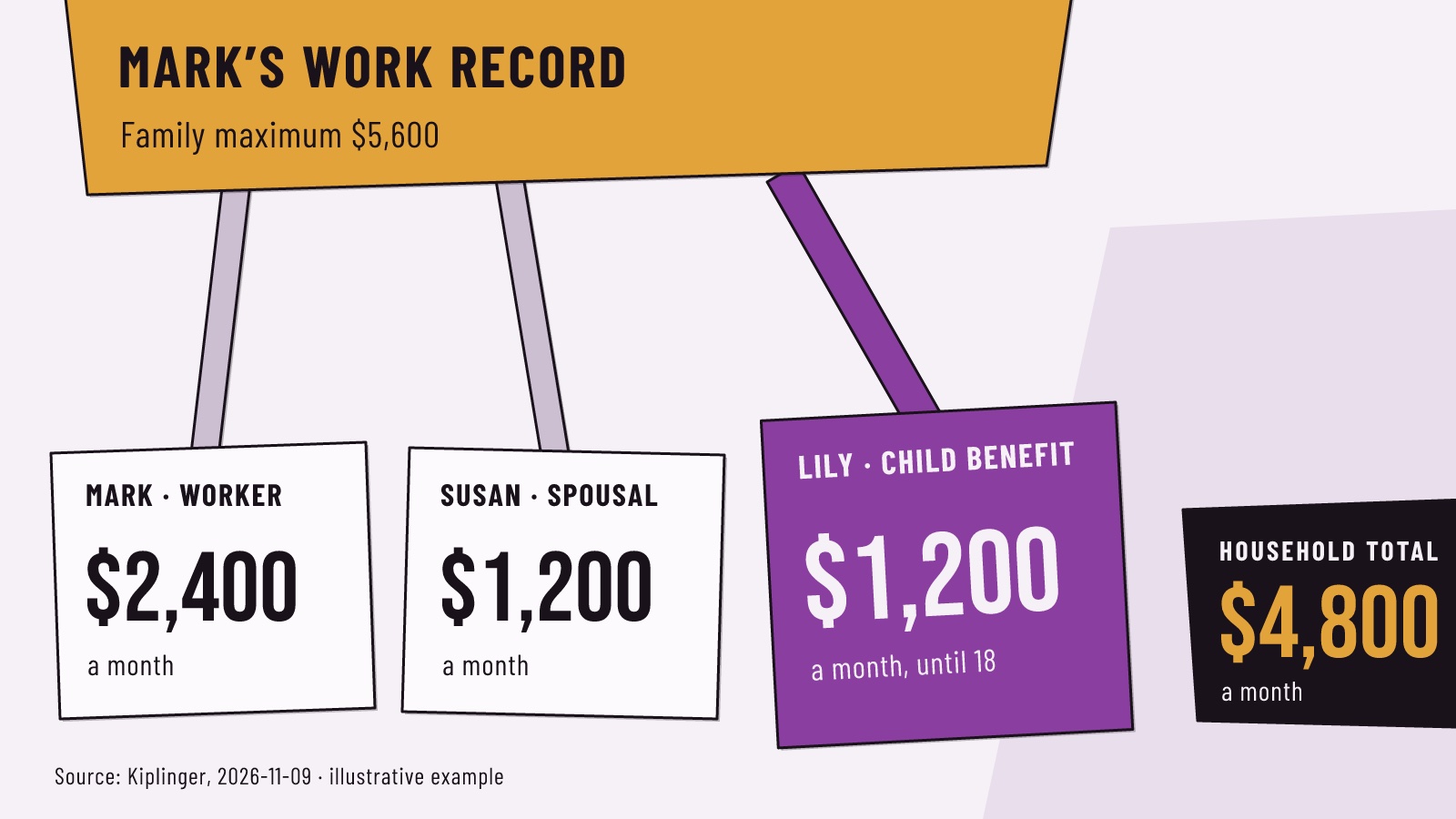
The family maximum is the ceiling on what one record can pay out to a household in total. With an illustrative $5,600 maximum, Mark would get $2,400 from his 63rd birthday and Susan and Lily $1,200 each, for a household total of $4,800 a month.
Why spousal and survivor benefits behave differently
A regular spousal benefit can reach up to 50% of the worker's full retirement age amount, reduced for early claiming. Delaying the worker's claim to 70 does not raise that 50% base. A spouse who waits past her own full retirement age earns no extra credits on the spousal check either. SSA coordinates her own benefit with the spousal one rather than paying both in full.
Survivor benefits work the other way. Credits the higher earner gains by delaying can raise the widow's later payment, which the adviser calls valuable protection for a younger spouse. At her survivor full retirement age a widow may collect as much as 100% of the relevant survivor figure, but SSA does not stack that on top of her own retirement check.
Early claiming has a lasting cost too. For anyone born in 1960 or later the full retirement age is 67, and claiming at exactly 63 cuts the worker's benefit by 25%, so $3,200 would fall to $2,400. The adviser cautions that this smaller check continues after the child's payments stop and can also lower the spouse's eventual survivor income.
As Ray put it: "The Social Security application might have Mark's name at the top, but Susan and Lily still belong in the calculation."
How to protect yourself before you file
A claiming date is hard to undo, so the protective habit is to test the decision against the whole household, not one statement. These checks draw on the steps the adviser describes.
- List everyone who might qualify on the work record, including a former spouse or an adult child with a disability, with the dates each person's eligibility starts and ends.
- Model three stretches separately: the years a child qualifies, the years after, and a possible widowhood, testing a long life for each spouse.
- Count the savings you would spend during any delay next to the larger retirement and survivor payments waiting might bring.
- If either parent still works, check whether earnings could lead SSA to withhold benefits for the worker and for family members.
If you pay someone for this analysis, look them up first. Kiplinger notes the column reflects the contributing adviser's views, not its editorial staff, and points readers to the SEC or FINRA to look up an adviser's record.
What to watch next
The figures in the column are illustrative, not a ruling on any real household, and the column reflects one adviser's views. The case shows how one filing choice can change income for a worker, a spouse and a child at once. Families with a minor child, a much younger spouse or a former spouse should check their own SSA estimates and eligibility dates before settling on a claiming age.
Sources
- Kiplinger, 9 Nov 2026
An AI model drafted this from the official notices and reports listed above. It was published automatically after software checks on figures and wording, without a human edit. It describes rules and protective habits; it is not personal financial advice.