News analysis ·
Saving for grandkids: who controls each account type
Kiplinger looks at launch funds for young adults. We explain who owns a 529, a custodial account and a Trump Account, and how givers protect their retirement.
Kiplinger reported on 2026-10-17 that some parents and grandparents are setting aside a so-called launch fund: money meant to help a child or grandchild after college, not just to pay tuition. This article looks at the account rules that decide who controls that money, and at the habit both advisers Kiplinger spoke to put first: protecting your own retirement before you give.
What Kiplinger reported
The idea grows out of a difficult entry-level job market. According to Kiplinger, a degree on its own may no longer be enough to make a young adult financially stable, so some families want a pot of money that can give a young adult a financial footing beyond tuition.
Kiplinger spoke with two certified financial planners. Tyler End is the CEO and a co-founder of Retirable. Beth Stenz is a financial adviser at Edward Jones. Both described a range of accounts, and both started from the same warning.
Your retirement comes first
Stenz put it plainly: "secure your own retirement before funding the next generation". Before earmarking money for heirs, she said, givers should check that their retirement savings are on track, that they hold an emergency reserve, and that they have a plan for possible health or long-term care bills.
End made the same point from a different side. A student can borrow for college, he noted, but nobody can borrow retirement income. A gift that leaves the giver short can turn into a burden for the very family it was meant to help.
This is the protective core of the story. Generosity is a choice you can repeat in later years. A retirement shortfall is much harder to repair once paychecks stop.
The rule that matters most: who owns the account
Every account type answers one question differently: who controls the money, and from when? Stenz suggested deciding how much control you want to keep, and for how long, before picking an account. She also suggested separate accounts for separate goals.
A taxable brokerage account owned by the grandparent stays in the grandparent's name. Per Stenz, there is no rule that the money must go to education, so it can be used wherever it helps most. Because the owner keeps control, the owner also keeps the decision about timing. Stenz added that money in such an account should be invested to match when it will be needed: a fund for a toddler can take more swings than one for a teenager. Invested money can fall in value, so any invested account can end up worth less than was put in.
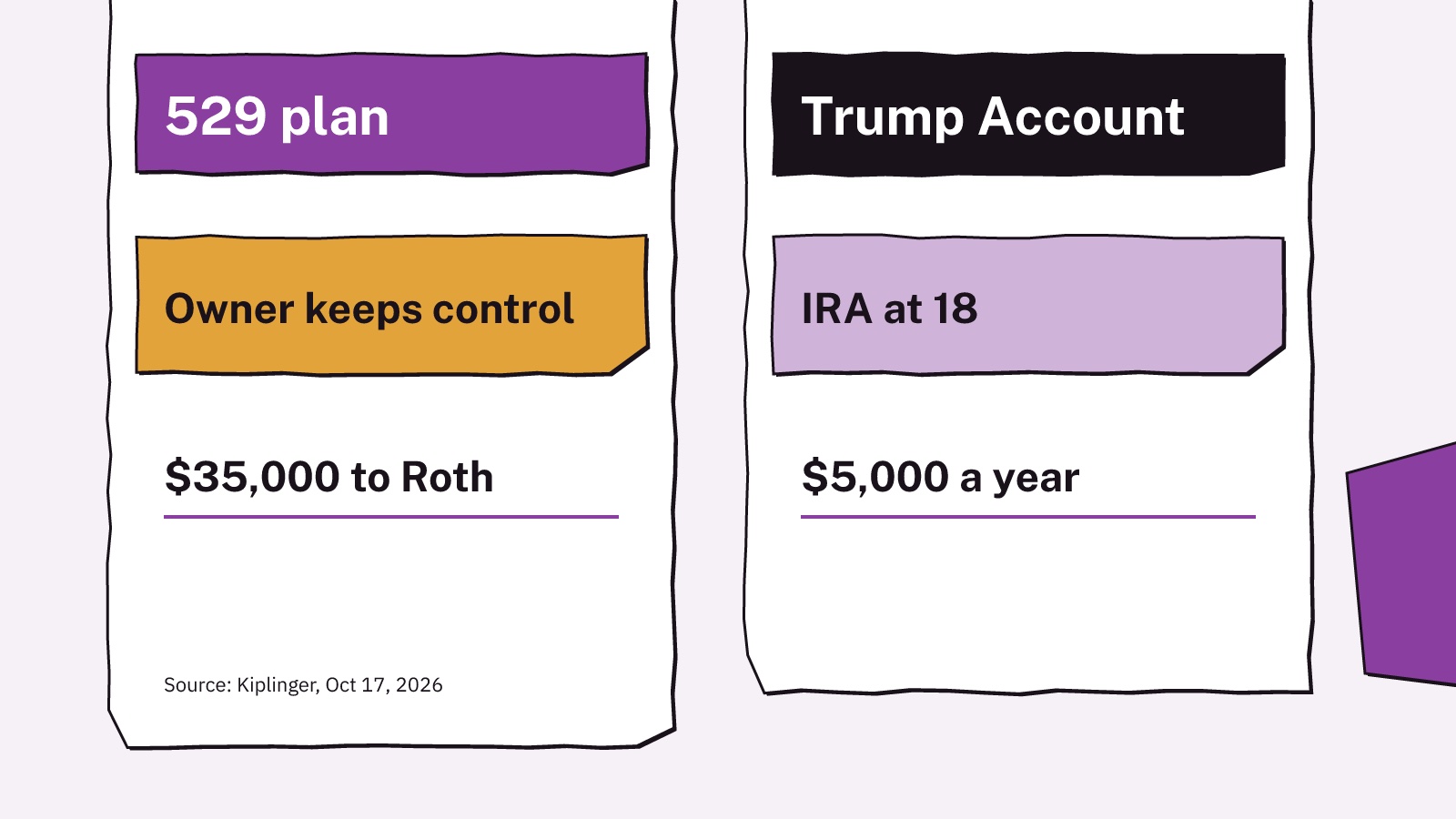
A 529 plan is a tax-advantaged education account. Stenz said a grandparent can open one with a grandchild as beneficiary, and the account owner, not the child, keeps control. The tax benefit has conditions. Earnings get favorable federal tax treatment only when withdrawals pay qualified expenses, and Kiplinger warned that using leftover money without penalties takes planning. After recent rule changes, a beneficiary may move a lifetime maximum of $35,000 into a Roth IRA, a retirement account funded with after-tax money.
A custodial account, usually set up under the UTMA or UGMA frameworks, works differently. End said full ownership passes to the child at a set age. Kiplinger cautioned that because the account belongs to the child, it may reduce the child's eligibility for college financial aid.
A Trump Account is the newest option. Stenz said each child's account can receive contributions capped at $5,000 annually, and gains grow tax-deferred, meaning tax is postponed until later. Nobody can withdraw the money before the child's 18th birthday, and at that point the account turns into a traditional IRA. Kiplinger noted it will not pay a young adult's rent or buy a car. It is a retirement head start, not spending money.
How to protect yourself
Before moving money into any of these accounts, a few checks can prevent costly surprises.
- Write down your own retirement, emergency and care-cost plans first, and give only from what is left over.
- Ask who legally owns the account and at what age, if any, control passes to the child.
- Read the withdrawal rules: what counts as a qualified expense, what is locked, and what triggers taxes or penalties.
- Talk with the young person you want to help, since their plans may make one account a poor fit.
That last check came from End. A teenager who already plans to skip college, for example, may be better served by a different account than a 529.
What happens next
One rule is still in motion. Kiplinger said some heavily funded 529 accounts would still hold more than a student could spend on education even after a $35,000 rollover. A Senate proposal would allow unlimited rollovers from unused 529 money into a Roth IRA, but Kiplinger described its fate as uncertain.
Until any change becomes law, the current limit is the one to plan around. Rules for these accounts have shifted recently, so it is worth checking the current terms with the plan provider or a qualified adviser before you commit money for many years.
Sources
- Kiplinger, 17 Oct 2026
An AI model drafted this from the official notices and reports listed above. It was published automatically after software checks on figures and wording, without a human edit. It describes rules and protective habits; it is not personal financial advice.