News analysis ·
FTC refunds Walmart money transfer scam victims
The FTC is mailing more than $9.8 million to people scammed through Walmart money transfers. How the refund works and how to spot a fake refund offer.
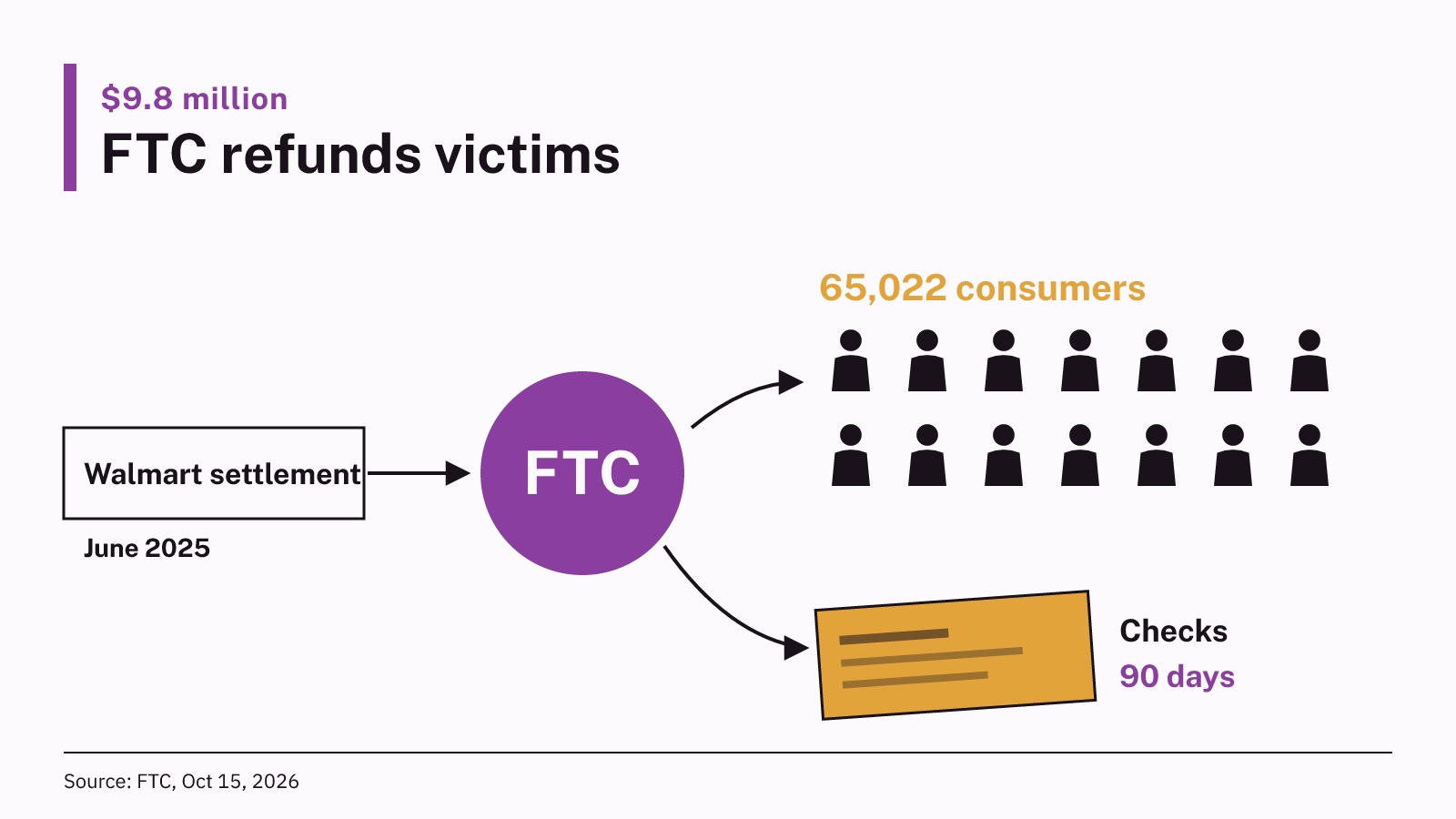
The Federal Trade Commission is sending more than $9.8 million to people who lost money to scammers who used Walmart's money transfer services. The payments follow a settlement over claims that the retailer did too little to stop fraud at its counters. This article explains how the refund reaches victims, why wire transfers are a favourite tool of scammers, and how to tell a real refund from a fake one.
What the FTC is paying out
According to the FTC, scammers used Walmart's money transfer services to take hundreds of millions of dollars from people in the U.S. The agency is now mailing checks to 65,022 consumers it judged to have been affected. Together the payments total more than $9.8 million.
The money is redress. Redress means money returned to people harmed by conduct that a regulator challenged. It rarely covers every dollar lost. It is the share that a settlement makes available, divided among the people who qualify.
The FTC says each check should be cashed or deposited within 90 days, the deadline printed on the check itself. Do not leave it sitting past that date. Questions go to the refund administrator, Rust Consulting Inc., and the FTC also posts answers about the redress process on its website.
The case behind the checks
The FTC complaint alleged that Walmart did not have effective anti-fraud policies and procedures for its money transfer business. It also alleged that staff were not properly trained and that customers did not get adequate warnings about fraud when they sent money.
Walmart settled the charges in June 2025. Under the settlement, the company must take steps to detect and block transfers that scammers trick customers into sending. These are often called fraud-induced transfers: the customer sends the money personally, but only because someone lied to them.
That detail matters. In many scams the victim is not hacked. They walk into a store, fill in a form and hand over cash, believing a story. The case was about whether the business in the middle should have noticed the warning signs and spoken up.
Why scammers like wire transfers
A cash wire transfer moves money fast and is hard to reverse. Once the receiver picks it up, there is usually no card issuer or bank to dispute the charge with. That is why so many scripts end with the same request: go to a store and send money to this name.
The stories change, but the pattern is steady. A caller claims to be from a government agency, a utility, a bank or a relative in trouble. There is urgency, a threat or a prize. And the payment must go by wire, gift card or another method that cannot easily be pulled back.
The protective habit is simple to state: any demand for an urgent wire transfer is a reason to stop, not to hurry.
How to protect yourself
Refund programmes attract their own scams. Fraudsters know victims are waiting for money, so they pose as refund agents. The FTC was direct about this. "The Commission never requires people to pay money or provide account information to get a payment." The agency added that it will never demand money, make threats, tell people to transfer funds or promise prizes.
- Treat any request for a fee, tax or account number before a refund as a scam, whoever claims to be asking.
- Look up the contact details for a refund administrator yourself on the regulator's official website instead of using a number from a call or message.
- Before sending a wire transfer, ask who benefits if the story is false, and pause long enough to check it with someone you trust.
- If you lost money, report it through the FTC's ReportFraud site, even if you think the money is gone.
This round of refunds is arriving by mailed check, with the deadline printed on it, not through a call asking you to act today.
What happens next
Recipients have 90 days to cash their checks. The FTC publishes interactive dashboards that break down redress payments by state, so readers can see how money from its cases is spread across the country. The agency's enforcement work returned more than $435 million to consumers nationwide in 2025.
For Walmart, the settlement terms point forward: it must detect and stop fraud-induced transfers. For everyone else, the case is a reminder that the counter clerk is not a safety net. The strongest protection is still the pause you take before the money leaves your hands.
Sources
- FTC, 15 Oct 2026
An AI model drafted this from the official notices and reports listed above. It was published automatically after software checks on figures and wording, without a human edit. It describes rules and protective habits; it is not personal financial advice.