News analysis ·
FTC elder fraud report: $3 billion lost, and how to stop it
Older Americans reported about $3 billion in fraud losses for 2025, the FTC says. How the costliest scams work and the checks that protect savings.
Americans aged 60 and older reported losing roughly $3 billion to fraud in 2025, according to the Federal Trade Commission's yearly report to Congress on fraud against older adults, as CNBC reported. Most of that money went in a small number of very large losses. This article looks at the schemes behind those losses, the tax hit that can follow, and the simple habits that make a six-figure loss much harder to pull off.
What the FTC found
Reported losses among older adults rose from $2.4 billion in 2024 to about $3 billion in 2025, a 25% rise. Against 2020, when reported losses were $600 million, the 2025 total is up 400%.
The striking part is how concentrated the damage is. Only 6% of older victims reported losing $100,000 or more, yet that group accounted for 70% of all reported losses in the age bracket. The number of people reporting losses of that size climbed from 1,136 in 2020 to 6,769 in 2025, close to a sixfold increase.
The reported totals are also a floor, not a ceiling. Many victims never file a report, so the FTC estimates that true 2025 losses fall somewhere between $13.3 billion and $119.5 billion. Its range for 2024 was $10.1 billion to $81.5 billion. Bob Blancato of the Elder Justice Coalition called the figures staggering and said scammers stay ahead of everyone.
The schemes that drain life savings
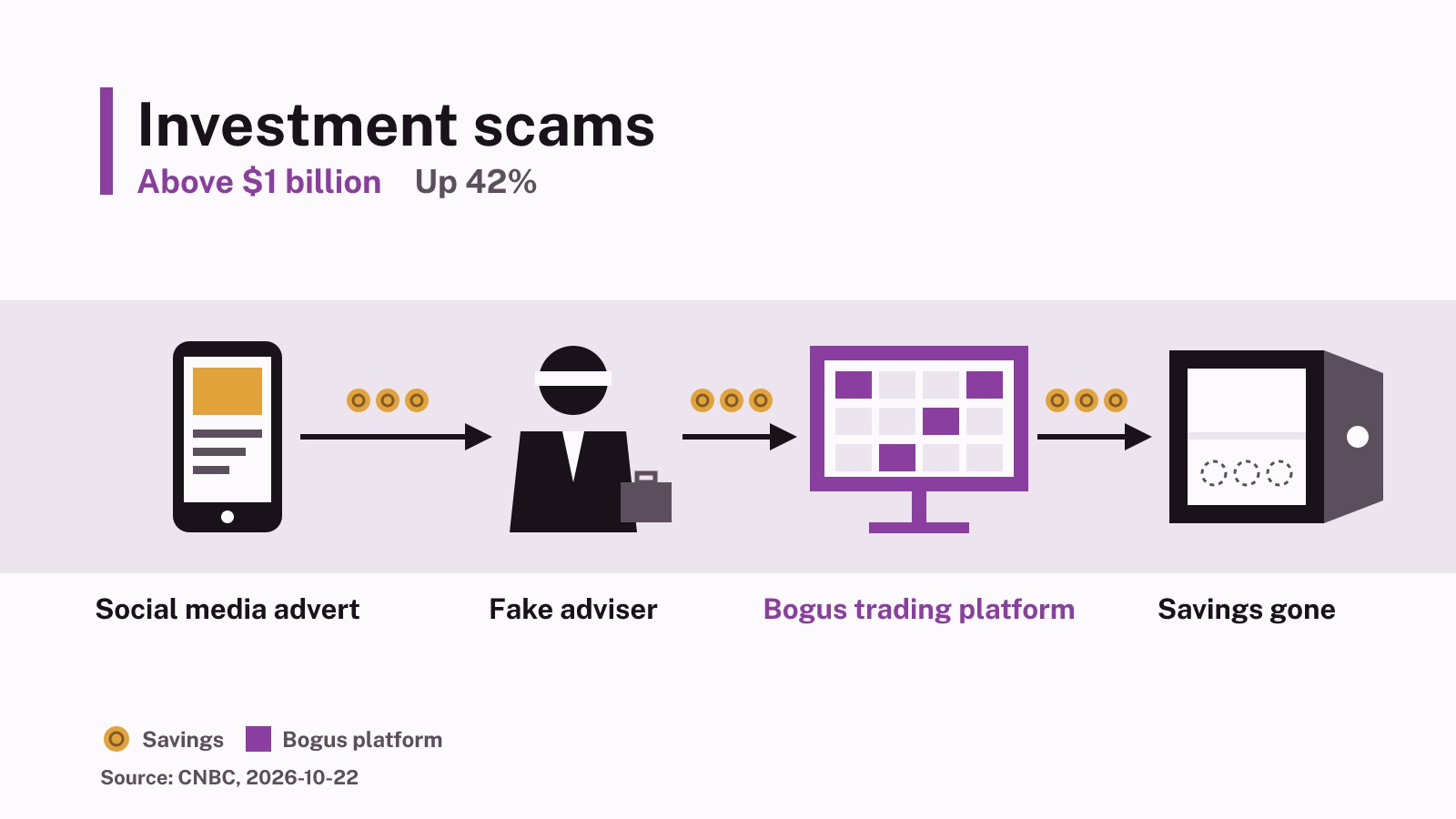
Investment scams were the most expensive category for older consumers in 2025, with losses above $1 billion, up 42% from 2024. According to the CNBC report, they often begin with a social media advert or a message from someone claiming to be a financial adviser. The victim is then steered to a trading platform that looks real but is controlled by the fraudsters.
Impersonation came next. Government impersonation scams led to $448 million in reported losses and business impersonation to $422 million. The script is usually the same: a caller posing as a bank or an agency invents an emergency, says your savings are at risk, and tells you to move money to keep it safe. That can mean a wire transfer, cash sent by mail or deposits into crypto ATMs. A real bank or agency does not ask you to move money to protect it.
The FBI says artificial intelligence has raised the volume of scams and made fake messages cheaper to produce and harder to spot. Polished writing or a familiar-sounding voice is no longer a sign that a contact is genuine.
The tax bill that can follow a scam
A loss can grow after the money is gone. If a victim withdrew funds from a traditional 401(k) or IRA to pay a scammer, the withdrawal may count as taxable income. Anyone under age 59½ may also face a 10% early-withdrawal penalty.
Deductions offer only partial relief. An IRS memorandum from March 2025 indicates that investment fraud losses may be deductible, but experts say losses to some impersonation or romance scams are not. Blancato summed up the problem: "You get scammed out of $100,000 and then you're paying taxes on that $100,000".
How to protect yourself
Most of these schemes depend on urgency and secrecy. The habits below slow things down and bring a second person into the decision.
- Name a trusted contact on every brokerage and retirement account. FINRA rules require brokerages to make a good-faith effort to collect one, but you can decline, so add one on purpose. That person can be called if the firm suspects exploitation.
- Treat any call, text or message that says your money is in danger as a warning sign. Hang up and contact your bank or the agency using a number you already have, not one the caller gives you.
- Before investing after an online advert or a message from a stranger, check that the adviser and the platform are registered, and be wary of any balance you cannot withdraw.
- Never take money out of a 401(k) or IRA because someone told you to on short notice. Talk to a family member or an adviser you chose first, because the withdrawal can trigger tax and a penalty.
If you think an older relative is being targeted, University of Minnesota professor Marti DeLiema advises a calm, non-judgmental approach. Avoid blame, and keep in touch, since scammers try to cut targets off from the people who might step in.
What happens next in Congress
Two bills that passed the House now wait in the Senate. The Tax Relief for Fraud Victims Act, which has support from both parties, passed in September by 408-17. It would remove the limits on deducting fraud losses and waive the 10% early-withdrawal penalty. It sits with the Senate Finance Committee, and its outlook is uncertain.
The Financial Exploitation Prevention Act passed the House in June by 414-2. It would allow firms such as mutual fund companies to hold a transaction for a short time when they suspect a customer is being exploited. It awaits the Senate Banking Committee.
Sources
- CNBC, 22 Oct 2026
An AI model drafted this from the official notices and reports listed above. It was published automatically after software checks on figures and wording, without a human edit. It describes rules and protective habits; it is not personal financial advice.